Market Letter - August 2026

Currencies: the dollar holds firm, while the yen falls to a new all-time low
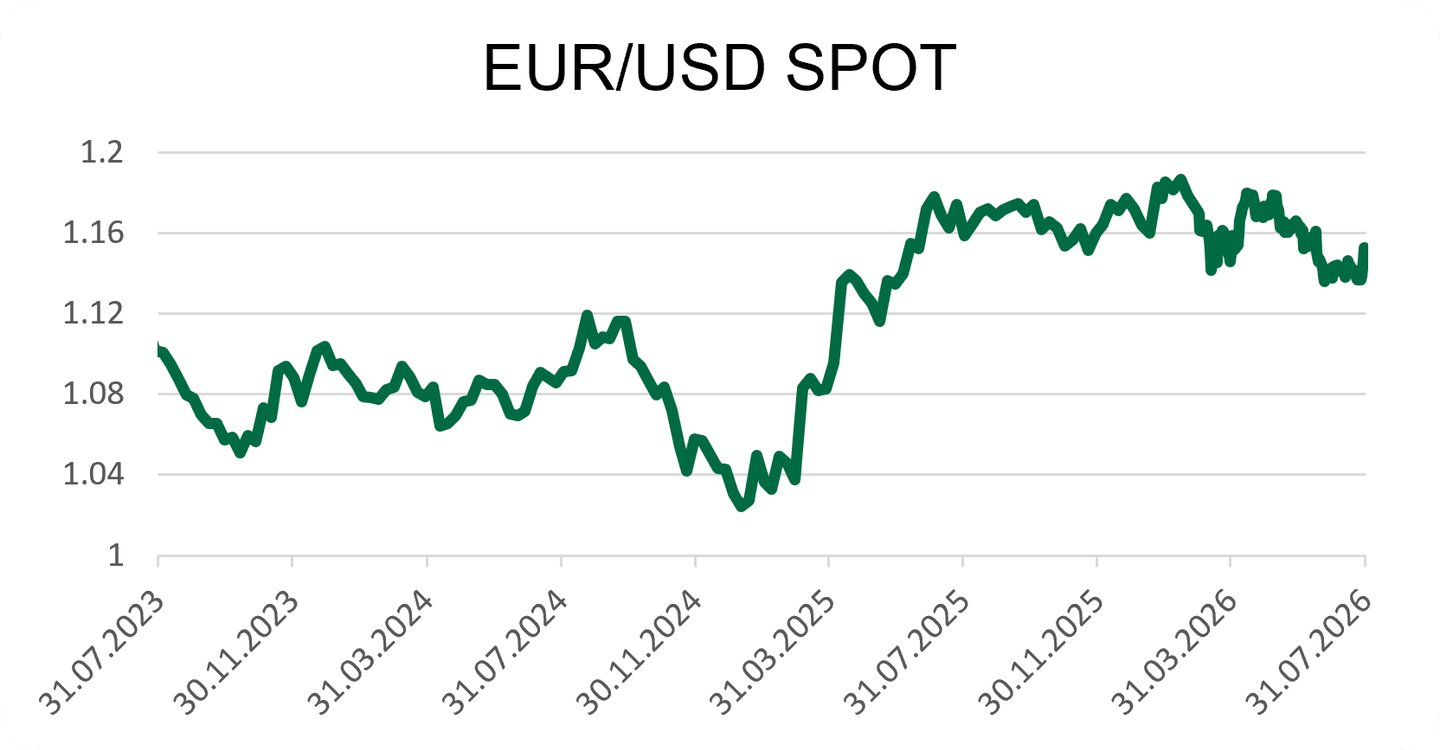
EURUSD: EURUSD rose by approximately 0.8% in July. The pair was trading at around 1.1380 at the beginning of the month and is now trading close to 1.15.
The dollar was supported during part of the month by geopolitical tensions and expectations that US interest rates would remain high for an extended period. However, it weakened toward the end of the month following the Federal Reserve’s meeting on July 29. The Fed kept its policy rate within a range of 3.50% to 3.75%, although three officials voted in favour of a 25-basis-point increase. The lack of clear guidance on the timing of future rate hikes weighed on the dollar and allowed the euro to move firmly back above $1.14.
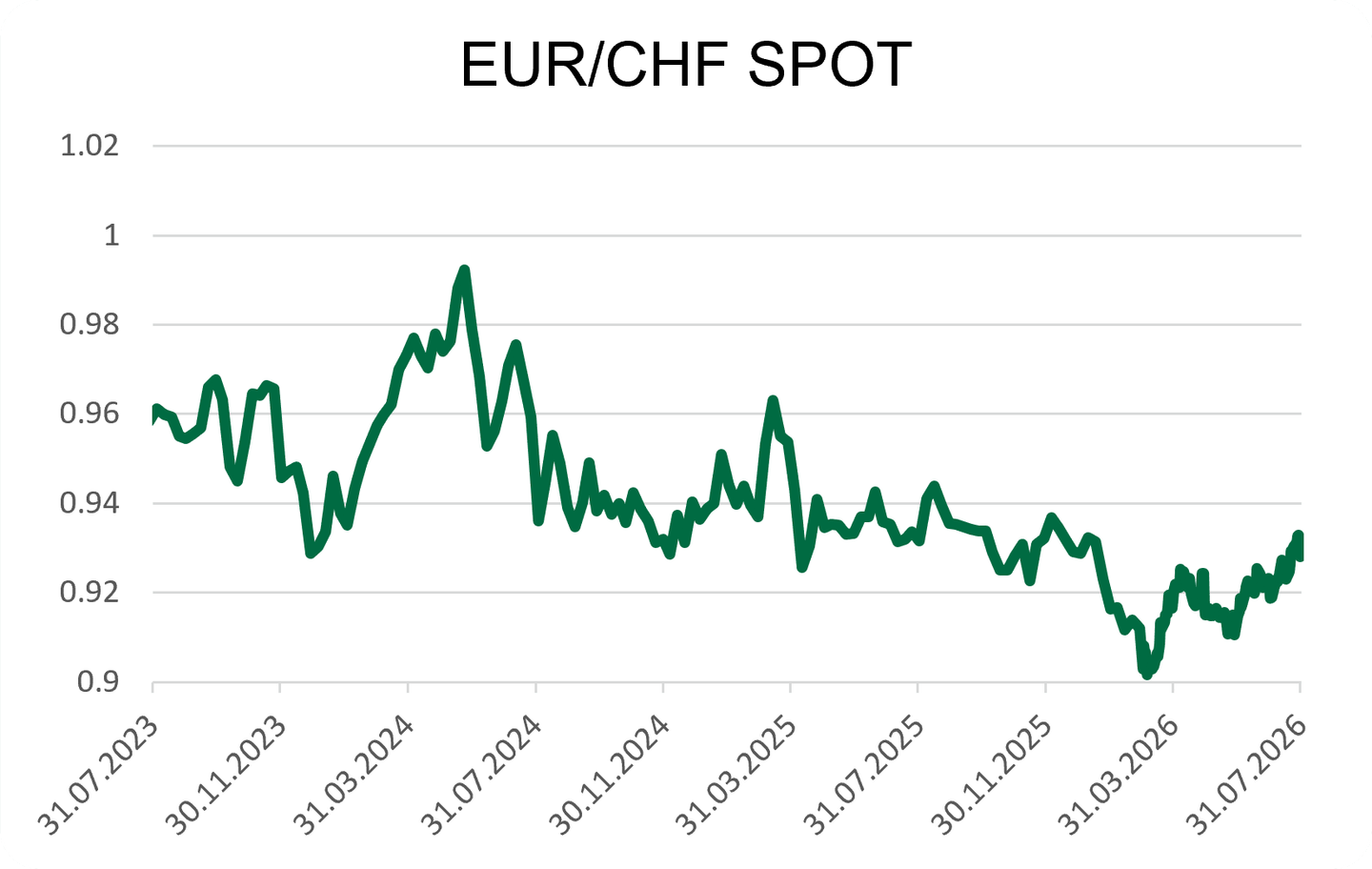
EURCHF: EURCHF rose by approximately 1% in July and is now trading at around 0.930.
The pair’s movements are now primarily driven by the interest-rate differential between the euro area and Switzerland. The ECB raised its deposit rate to 2.25% in June before keeping it unchanged at its July 23 meeting, while the Swiss National Bank maintained its policy rate at 0%. As interest rates have risen more sharply in the euro area than in Switzerland, euro-denominated investments have become relatively more attractive, supporting EURCHF. Nevertheless, the SNB remains prepared to intervene to prevent an excessively rapid appreciation of the Swiss franc.
EURCNY: EURCNY remained broadly stable in July and is now trading at around 7.75 yuan per euro.
The Chinese economy slowed in the second quarter, with GDP growth of 4.3% year on year, compared with 5% in the first quarter. Credit support remains limited: growth in outstanding loans slowed to 5.2% year on year in June. However, total social financing rebounded to CNY 3.36 trillion in June, from CNY 2.03 trillion in May, indicating a monthly improvement but not yet a sustained recovery in the credit impulse. The People’s Bank of China continues to maintain an accommodative monetary policy, with the seven-day reverse repo rate set at 1.40%. The loan prime rates also remain unchanged at 3% for one year and 3.50% for five years.
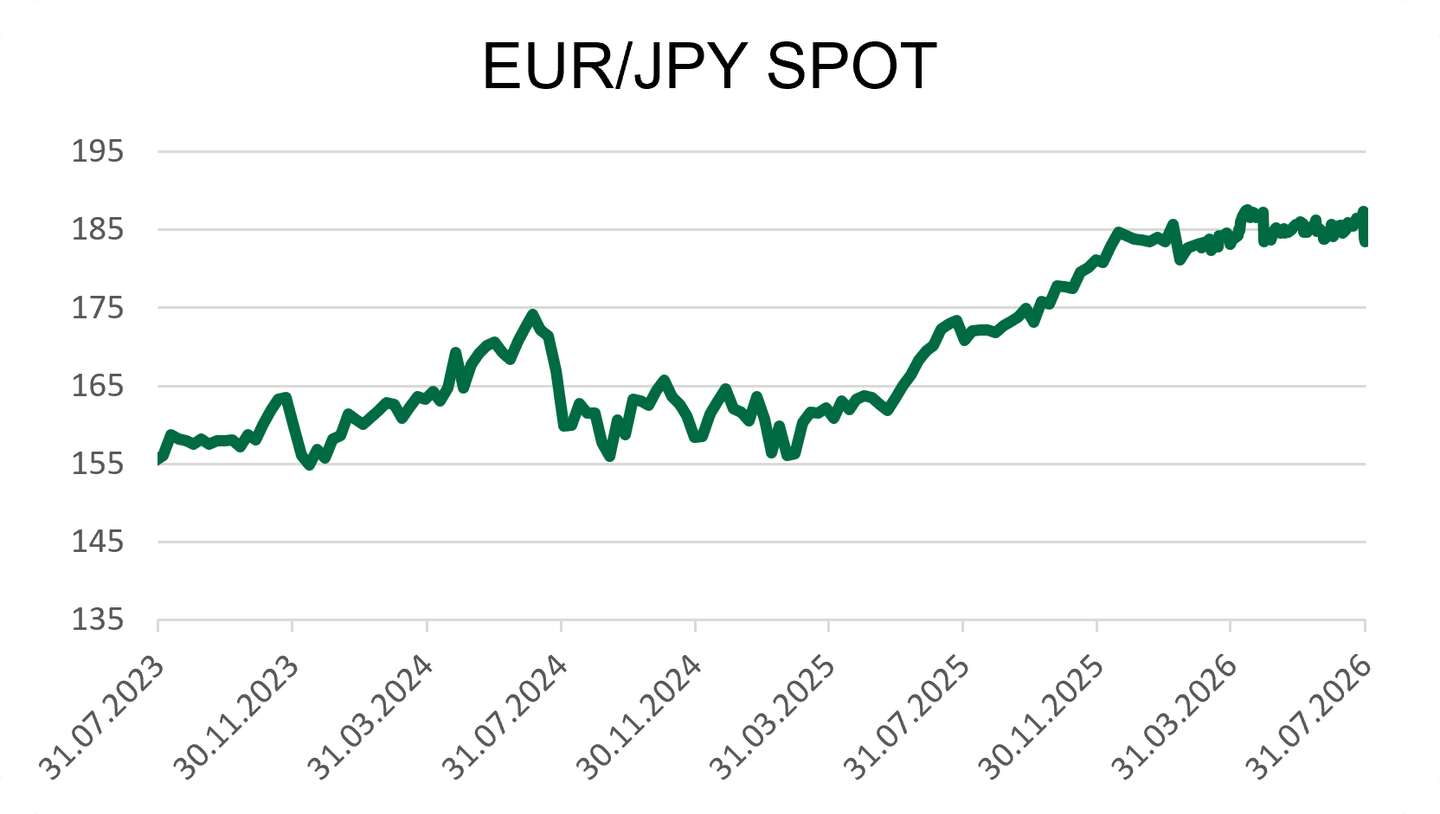
EURJPY: EURJPY is trading at around 184.5 yen per euro, down slightly by approximately 0.4% since the beginning of the month.
The yen appreciated sharply on July 30 following an intervention by the Japanese authorities in the foreign exchange market, leading to a rapid decline in EURJPY. However, part of this movement was reversed after the Bank of Japan’s meeting on July 31. The BoJ kept its policy rate at 1%, although one official voted in favour of raising it to 1.25%. Japanese interest rates remain significantly lower than those of other major economies, which continues to limit the yen’s potential for sustained appreciation despite intervention by the authorities.
Interest rates: The ECB pauses, but the recent surge in energy prices continues to fuel inflationary pressures
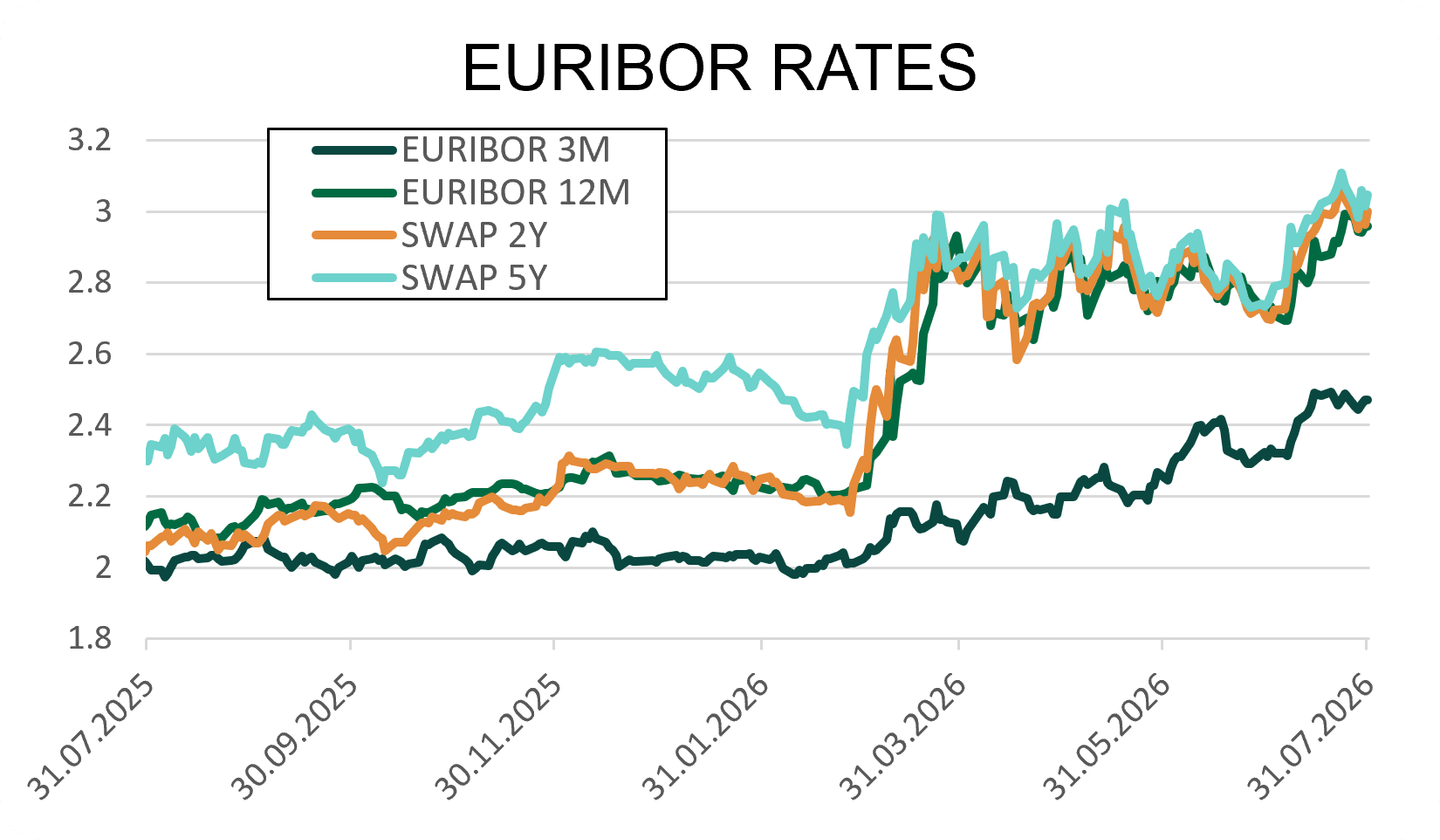
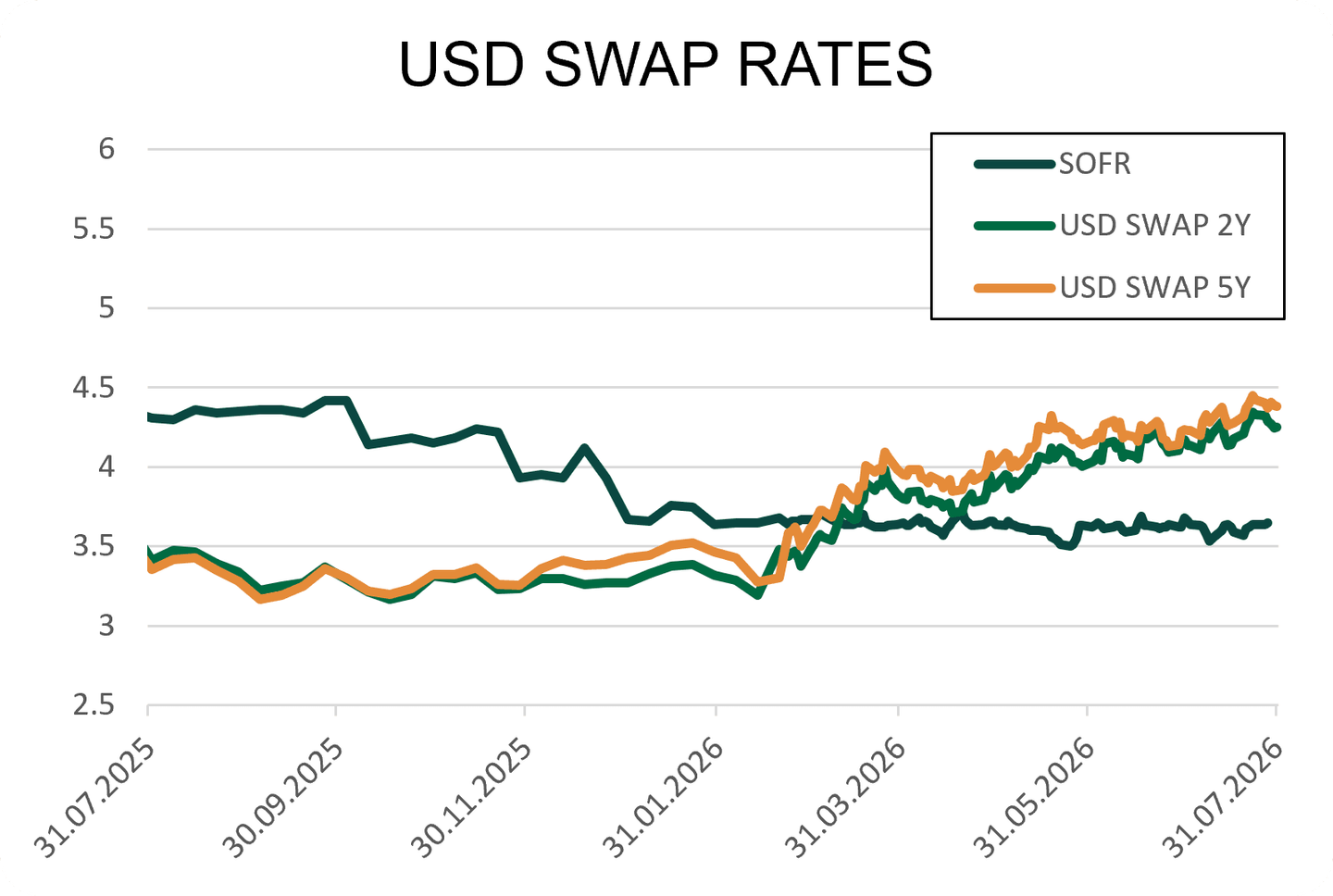
United States: The Federal Reserve kept its policy rate within a range of 3.50% to 3.75%. The decision was approved by nine votes to three, with the three members opposing the status quo favouring a 0.25-percentage-point increase. The Fed remains cautious in the face of persistently high inflation and risks linked to energy prices. Its next meeting will take place in September. Bond markets nevertheless reacted strongly following the meeting. The yield on 30-year US Treasuries climbed to around 5.24%, its highest level in nineteen years. This increase shows that investors are demanding higher returns to compensate for inflation risks and uncertainty surrounding the Fed’s monetary policy. US inflation slowed to 3.5% year on year in June, from 4.2% in May. However, it remains well above the Fed’s 2% target. Data released on July 30 also showed that US GDP grew at an annualised rate of 1.5% in the second quarter, following growth of 2.1% in the first quarter. Growth was supported by household consumption, investment and exports, while lower government spending and higher imports weighed on economic activity. Dollar-denominated financing therefore remains expensive for businesses. The increase in the 30-year yield also raises the cost of long-term borrowing, even though the Fed did not increase its policy rate.
Eurozone: The European Central Bank left its interest rates unchanged in July after raising them in June. The deposit facility rate remains at 2.25%, the main refinancing rate at 2.40% and the marginal lending facility rate at 2.65%. The ECB has provided no clear guidance for the coming months and will continue to make decisions based on new economic data and developments in inflation. The euro-area economy nevertheless rebounded in the second quarter. GDP increased by 0.4% compared with the previous quarter, after stagnating in the first quarter. Year-on-year growth reached 1%, indicating an improvement in economic activity, although the recovery remains uneven across countries. Euro-area inflation slowed to 2.8% in June, from 3.2% in May. However, it remains above the ECB’s 2% target. The euro-area unemployment rate stood at 6.3% in June, unchanged from both May 2026 and June 2025. For European businesses, the rebound in growth is positive for demand, but financing costs remain high, particularly for companies with debt linked to Euribor or those that need to refinance their borrowings in the near future.
United Kingdom: The Bank of England kept its policy rate unchanged at 3.75%. Six members voted to maintain the status quo, while three members favoured an increase to 4%. The number of policymakers supporting a rate increase has therefore risen since the previous meeting. UK inflation slowed to 2.6% in June. However, the Bank of England expects it could rise again in the coming months because of higher energy prices. In its central scenario published on July 30, it now forecasts average inflation of 3.2% in the fourth quarter of 2026. It therefore remains cautious despite the easing of domestic inflationary pressures. The political environment has also changed. Andy Burnham replaced Keir Starmer as Prime Minister on July 20. The new government aims to support household purchasing power, expand social housing, reindustrialise the country and strengthen public control over certain essential services. The main challenge is now to finance these measures without weakening the public finances. The new Chancellor of the Exchequer, John Healey, has stated that he intends to comply with the fiscal rules, but markets are monitoring the risk of higher taxes or increased borrowing in the next budget. Sterling-denominated financing therefore remains expensive for businesses. Fiscal uncertainty and inflation risks could also keep UK bond yields at elevated levels.
Japan: The Bank of Japan maintained its policy rate at 1% at the end of its July 31 meeting, after raising it in June. The decision was approved by eight votes to one. Hajime Takata opposed the decision to maintain the status quo and favoured an increase to 1.25%. The central bank indicated that it would continue to raise interest rates gradually if developments in economic activity, prices and financial conditions remain consistent with its forecasts. The Bank of Japan now forecasts median underlying inflation of 2.5% for fiscal year 2026, compared with 2.8% in its April projections. Japanese inflation reached 1.7% in June. Core inflation, which excludes fresh food, stood at 1.6% and remains below the central bank’s 2% target. Yen-denominated financing remains relatively favourable for businesses, although its cost could continue to rise if the Bank of Japan gradually proceeds with the normalisation of its monetary policy.
China: China kept its main benchmark lending rates unchanged in July. The one-year rate remains at 3%, while the five-year rate, which is used in particular for mortgage lending, remains at 3.50%. Chinese inflation slowed to 1% in June, from 1.2% in May. Weak price pressures continue to give the authorities some room to support the economy should activity slow further. Indicators published on July 31 nevertheless showed a deterioration in economic activity. The official manufacturing PMI fell to 49.2 in July, from 50.3 in June, while the non-manufacturing PMI declined to 49.0, from 50.2. As both indices are below the 50-point threshold, they signal a contraction in manufacturing as well as in services and construction. For businesses, yuan-denominated financing remains relatively accessible, although weak domestic demand continues to weigh on economic activity.
Commodities: Oil falls back after its sharp rally, while sulfur and AI computing power remain expensive
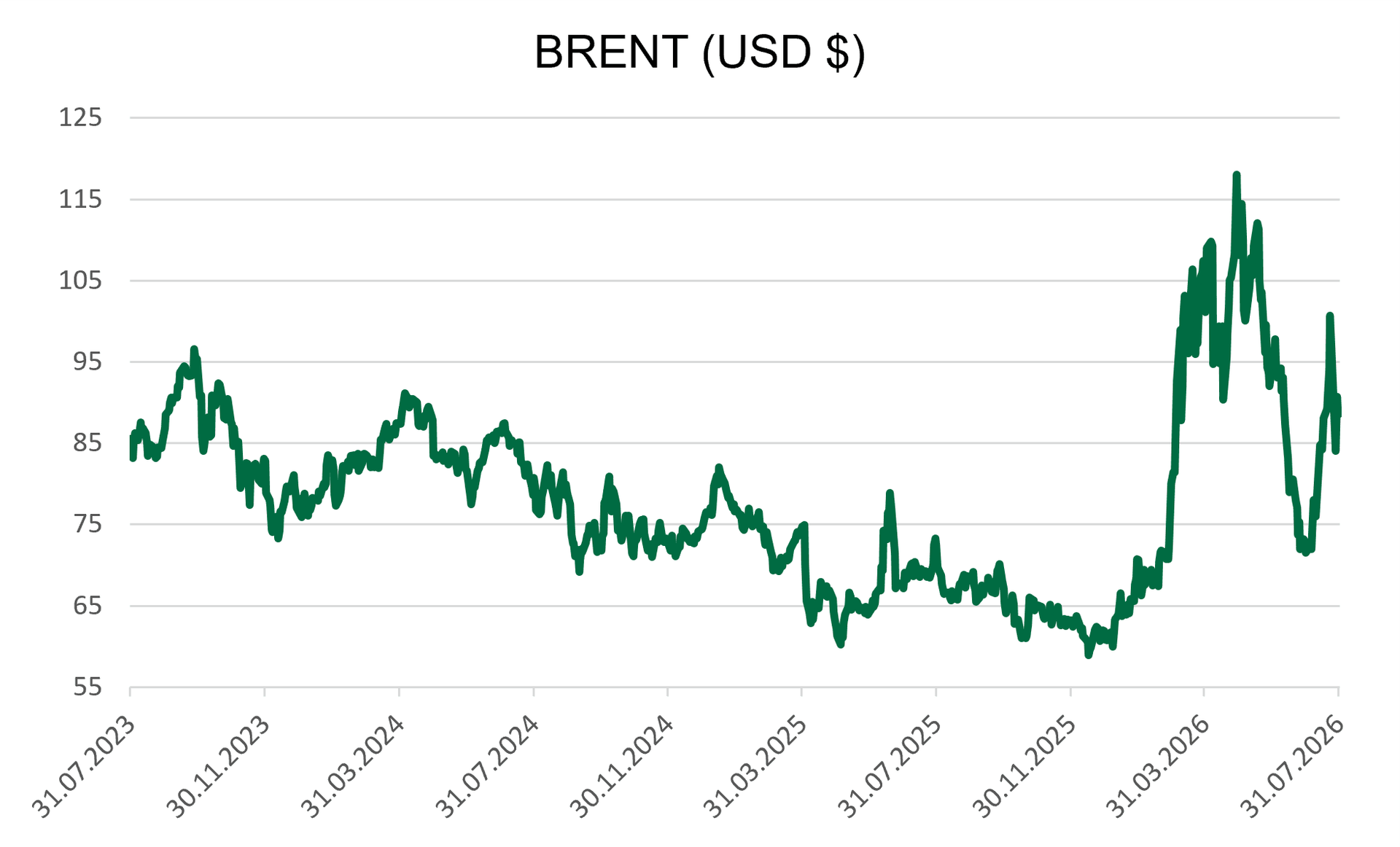
Oil: Oil prices fluctuated sharply in July. Brent crude rose above $100 per barrel on July 23, due to escalating tensions in the Middle East and risks affecting maritime transport. It then fell back to around $88 on July 27, following a pause in fighting between the United States and Iran. Brent subsequently rebounded after military operations resumed, before returning to around $86 per barrel. It remains up approximately 20.2% over the month.
Oil prices remaining below the levels reached on July 23 provides some relief for companies in the transport, logistics, chemicals and plastics sectors. However, the risk remains very high, as traffic through the Strait of Hormuz continues to be disrupted. Some signs of improvement have nevertheless emerged, with Qatar sending its first LNG carrier through the strait in more than three weeks. A further escalation of the conflict could, however, quickly push prices higher again.
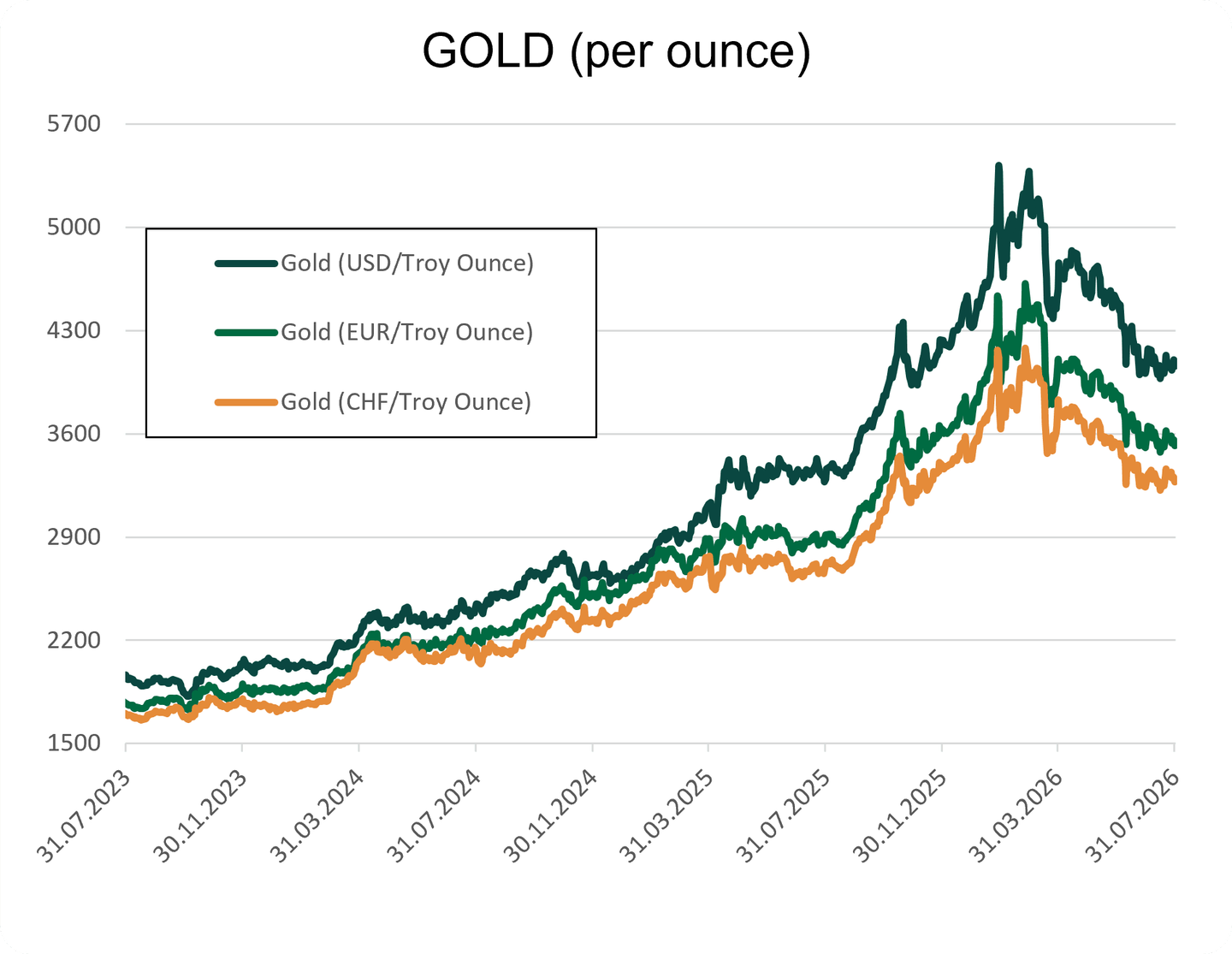
Gold: Gold is trading at around $4,060 per ounce. It gained approximately 0.7% in July, despite a strong dollar and high interest rates. International tensions continue to support demand for the metal, which is regarded as a safer investment.
Gold prices are therefore likely to remain sensitive to developments in the conflict, the dollar and Federal Reserve policy.
Sulfur: The latest available benchmark price for sulphur stands at around CNY 9,186 per tonne. After falling by 4.5% on July 27, it rebounded by 1.1% on July 30. It remains up approximately 2% over one month and nearly 273% over one year. It is still below the record of around CNY 11,084 reached in June. Its high price therefore continues to weigh on agricultural, chemical and mining companies.
Natural gas / LNG: In the United States, natural gas is trading at around $2.76 per million BTU. Inventories remain approximately 6.4% above their five-year average, limiting upward pressure on prices.
In Europe, the situation is more difficult. The benchmark TTF gas price is trading at around €58.3 per megawatt-hour. It fell by approximately 6% on July 27, but remains up around 35.6% over the month. European storage facilities are approximately 55% full, which is below their seasonal average.
Competition with Asia for liquefied natural gas, or LNG, cargoes also remains strong. In June, the average Asian price was higher than the European price, prompting some US exporters to send more gas to Asia. Europe’s share of US exports consequently fell to around 42%. Transport conditions through the Strait of Hormuz are nevertheless showing initial signs of improvement, although conflict-related risks remain high.
European industries that consume large amounts of gas therefore remain exposed, particularly chemicals, fertilisers, glass, paper and metallurgy.
GPU / AI: Computing costs remain high for companies developing artificial intelligence tools. In July, rental prices for commonly used GPUs, such as the Nvidia H100, H200 and A100, remained broadly stable. An H100 costs an average of around $3.15 per hour, although rates can exceed $10 at some major providers. Newer models, such as the B200 and B300, remain more expensive and less widely available. Long-term contracts also remain under pressure. Electricity, cooling, storage and data-centre costs add to these expenses. Computing costs are therefore expected to remain high, particularly for the latest-generation GPUs and capacity guaranteed over several months.
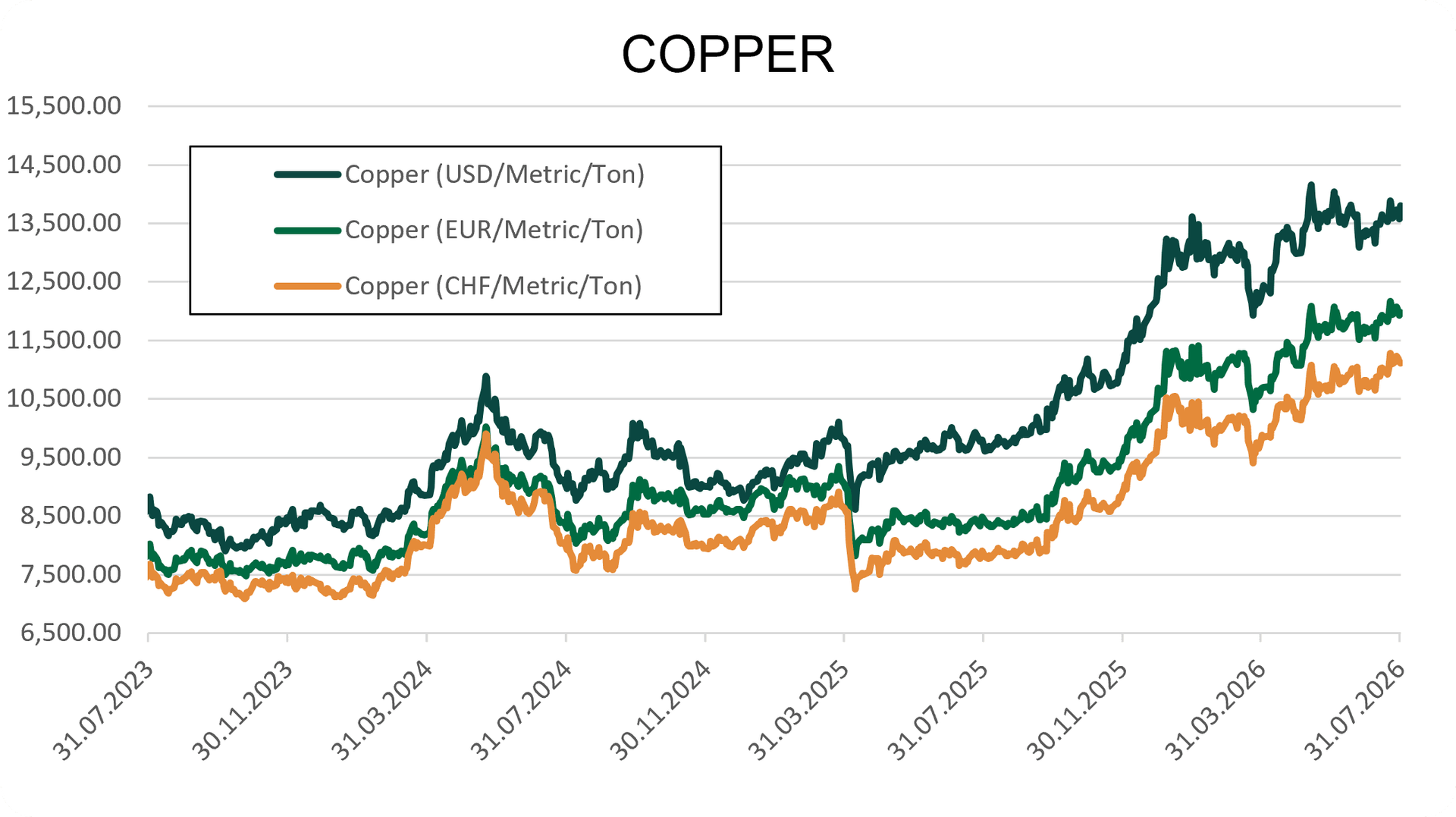
Copper: Copper is trading at around $14,286 per tonne, up approximately 5.8% in July. It remains close to its June record of around $14,700 per tonne.
Demand continues to be supported by power grids, electronic equipment, renewable energy and the development of data centres linked to artificial intelligence. China also remains a key factor in the market’s direction.
For businesses, these high prices increase the cost of cables, motors, electrical equipment, cooling systems and certain components used in construction and the automotive industry.
This market report was prepared on 07/31/2026.

OUR TEAM SUPPORTS YOU
Kerius Finance brings together a team of passionate experts dedicated to analyzing, managing, and optimizing financial risks. Our approach is based on transparency, rigor, and attentiveness, enabling us to fully understand your challenges and provide tailored solutions.